Tuesday, June 29, 2010

Knitting together the kindergarten standards

Here's a further thought on why knitting the new standards together into creative combinations will be essential:  kindergartners are expected to work on first steps toward 28 of the 32 college and career readiness anchor standard, and also on six reading foundation standards.

Designing separate activities for each one could so easily end up being deadly worksheets on isolated skills, and that's the wrong approach to early learning.

To avoid that, classic activities for that age will need to be the main routes to success with the new expectations. I think it can be done.

To check, I've been imagining a classroom study of Make Way for Ducklings: not just reading the book once, but planned work over a couple of days to let children learn the full story and think through some of its details.

Yes, that could give all students experience working on the first reading standard, which wants student to be able to "ask and answer questions about key details in a text," with the added guidance that they should be doing that with "with prompting and support."  They could sort out why Mr. and Mrs. Mallard didn't build their first nest in the Public Garden, but did move the ducklings later on.

With the same "prompting and support," the next two reading standards want students to be able to "retell familiar stories, including key details" and "identify characters, settings, and major events in a story." Oh, the swan boats! Oh, the police whistles!

At least four more look easy to include to me:
  • With prompting and support, name the author and illustrator of a story and define the role of each in telling the story. 
  • With prompting and support, describe the relationship between illustrations and the story in which they appear (e.g., what moment in a story an illustration depicts). 
  • Confirm understanding of a text read aloud or information presented orally or through other media by asking and answering questions about key details and requesting clarification if something is not understood. 
  • Speak audibly and express thoughts, feelings, and ideas clearly. 
With a little more design work, I think there's also a good opening for progress on two from writing:
  • Use a combination of drawing, dictating, and writing to compose opinion pieces in which they tell a reader the topic or the name of the book they are writing about and state an opinion or preference about the topic or book (e.g., My favorite book is ...).
  • With guidance and support from adults, respond to questions and suggestions from peers and add details to strengthen writing as needed.
For all of those, teachers will need to work out how they can confidently plan the activities, track how students participate, and identify the best next steps for each one.  Building those skills, and the confidence and energy to deploy them steadily, will be the big task of the coming years.

Sunday, June 27, 2010

29,000 high school seniors in math remediation?

Friend-of-the-blog Cindy Baumert just encouraged me to take a look at the proposed revisions to Kentucky's graduation regulation, scheduled for a public hearing on July 28.  Don't miss the new provision that:
If students do not meet the college readiness benchmarks for mathematics as established by the Council on Postsecondary Education, ... a mathematics transitional course or intervention which shall be monitored to address remediation needs shall be required before exiting high school. [Emphasis added.]
In past law, that support has been offered to students rather than required. Thus, KRS 158.6459(2) specifies that:
A high school student whose score on the ACT examination ... in English, reading, or mathematics is below the systemwide standard established by the Council on Postsecondary Education for entry into a credit-bearing course at a public postsecondary institution without placement in a remedial course or an entry-level course with supplementary academic support shall be provided the opportunity to participate in accelerated learning designed to address his or her identified academic deficiencies prior to high school graduation. [Emphasis added.]
How big an impact will the mandate have?  Well, in the spring of 2009, when Kentucky tested 43,511 juniors, it found:
  • 23,713 students scoring below CPE's English benchmark of 18.
  • 28,822 students scoring below CPE's mathematics benchmark of 19.
  • 27,024 students scoring below CPE's reading benchmark of 20.
Those results are not (repeat, not) out of line with ACT's national norm sample results for high school seniors, shown in the ACT Technical Manual.

They are, however, a reminder that Kentucky, like the nation as a whole, needs to raise student achievement substantially.

Most of all, they are an indication that this amended regulation will demand a truly huge effort from our high schools, starting almost immediately.

New standards: how much knitting together?


The new Common Core Standards look to me like pretty good ladders, already close to being broken down to the individual steps students will need to climb--as I explained in my earlier post today.

On the other hand, tackling those standards one at a time looks just about impossible.  There are ten anchor standards for reading, ten for writing, six for speaking and listening, and six for language (including spelling, grammar, and related elements), and reading is broken down into varied versions (literary, informational, history, science) at different levels.  

Instead, classroom implementation is going to require creative combinations of standards into larger units of study.  For example, students might spend four weeks exploring a major science question.  The process could include reading, structured discussions, note-taking, and developing both sturdy short written reports and engaging presentations.  That unit can move students forward on several reading standards, several writing standards, and sections of the speaking and listening requirements--as well as the science itself.

Working out those combinations and planning student work that moves up three or four of those standards-ladders simultaneously will be a major undertaking for educators in Kentucky and all the other states moving into Common Core implementation. 

For me, this is a big shift in thinking about the work ahead.  If breaking down the individual standards now seems like relatively minor work,  knitting together multiple standards into classroom plans looks like the main challenge of the weeks and months ahead. 

New standards: how much breaking down?

Rick Stiggins and his colleagues make a compelling argument that clear ladders of expectations are essential to learning success. Students need to be able to look at current work, see how they've moved up a rung from earlier efforts, and see what added rung they need to reach for next.  Teachers must convert official standards into workable steps that students can climb that way.  That conversion process is spoken of as "deconstructing" or "breaking down" state or district standards for classroom use, working to create usable scaffolds for students to move up.

With Kentucky's new Common Core Standards, how big will that task be?

Before I saw the documents, I thought it would be huge.  Now that I've wrestled them a dozen ways and spent two days with quite wonderful practicing educators, I'm rethinking that.

As an example, under Writing Standard 8:

• Kindergarten and first grade students "recall information from experiences or gather information from provided sources to answer a question," with the specification that they do the work "with guidance and support from adults."


• Second graders do similar work with more independence.


• Third graders begin choosing their own sources (both print and digital) and taking brief notes. As they gather their evidence, they sort it into categories their teachers provide.


• Fourth graders decide on their own categories for sorted information, expand their note-taking, and begin including a source list with their writing.


• Fifth graders continue all that, adding skill in summarizing and paraphrasing in their notes and finished writing.


• Each later grade notches up the expectations a bit further, ending with college and career ready students who can "gather relevant information from multiple print and digital sources, assess the credibility and accuracy of each source, and integrate the information while avoiding plagiarism." 
    To me, that looks very close being a clear scaffold or ladder already.  The other standards have the same sort of progressions built in.

    With the Common Core Standards, I think the initial Stiggins-style deconstruction work will be a relatively quick and simple process.

    Saturday, June 26, 2010

    New Look!

    Yes, we've changed the look of the blog, so that we can:

    • Show you part of the post and let you click more to read the rest.
    • Make some semi-permanent information available with a row of tabs across the top of the blog.  Our summary of Senate Bill 1 is there now, and we're planning to add similar pages for major state education initiatives and major student achievement results soon.
    • Let you see our regular topic list in the left margin and the current headlines on the right.
    We hope you find the changes helpful, and do let us know your thoughts.

    Tuesday, June 22, 2010

    Balanced assessment here, now

    Direct from the Kentucky Association of School Superintendents' meeting, Brad Hughes is reporting on classroom assessments that are already applying balanced assessment principles, as well as on Commissioner Holliday making the case for statewide efforts. Here are the teacher voices:

    A course at Asbury University in Wilmore has taken Stiggins’ approach and its graduate students are putting it in place in their K-12 classrooms. Two of those students are Robin Lowe, a kindergarten teacher at Jessamine County’s Early Learning Village and Yvonne Crank, a fourth-grade teacher in the Woodford County system.
    “Students need to know ‘Where am I going and where am I now?’ and how to close the gap. Students need to have a vision of where their learning is going,” Crank said. “I can do that by placing before them learning targets, giving them examples of what quality work looks like.”

    Monday, June 21, 2010

    Centre's new teaching quality recognition

    U.S. News and World Reports has rated Centre College 11th in the nation for liberal arts college teaching quality.  From watching one particular professor work his craft every day, I'm not a bit surprised.

    Standards, testing, RTTT and some fresh details

    $320 million in Race to the Top money is on the table to support new assessments to support multi-state standards and replace current NCLB testing.

    At EdWeek's Curriculum Matters, Catherine Gewertz offers some fresh detail from an annual assessment conference for chief state school officers. 

    The Smarter/Balanced Consortium:
    • Includes 30 member states, including Kentucky.

    Saturday, June 19, 2010

    2009 high-performance, high-poverty schools

    At every level, Kentucky has schools that serve mainly students whose families have very low incomes and deliver student results in the top 25 percent statewide.  Key state leaders (here and here) reminded me that I couldn't immediately name our 2009 high-performance, high-poverty schools, so I spent yesterday evening on a hero-hunt.

    I started with state counts of students eligible for the federal free lunch program.  Then, I lined up the lunch numbers with the schools' 2009 transition index results.  For each school, the transition index is an unofficial number that sums up all a school's results on the Kentucky Core Content tests, providing a single number on a 0 to 140 scale with a 100 being equivalent to the average student having reached proficiency in all five.  That allowed me to find schools in the top 25 percent for both free lunch participation and academic results.

    I'm delighted to call these results to your attention and spotlight these schools as examples of places that achieve excellence against intensive odds.

    2009 Elementary Schools
    Results based on scores for grades 3-5 or, for K-6 schools, grades 3-6
    • 115 index at Union Chapel Elementary (a Russell County school with 70% free lunch participation)
    • 115 index at Duff Elementary (Floyd County, 73% free lunch)
    • 113 at Kimper Elementary (Pike County, 73%)
    • 112 at Ezel Elementary (Morgan, 73%)
    • 110 at Rightfork Center (Bell, 75%)
    • 109 at McDowell Elementary (Floyd, 78%)
    • 109 at Bethel Elementary (Bath, 70%)
    • 109 at Jones Fork Elementary (Knott, 72%)
    • 108 at Tompkinsville Elementary (Monroe, 67%)
    • 108 at Cuba Elementary (Graves, 67%)
    • 107 at Meade Memorial Elementary (Johnson, 67%)
    • 107 at Burnside Elementary (Pulaski, 72%)
    • 106 at J M Stumbo Elementary (Floyd, 82%)
    • 105 at Eubank Elementary (Pulaski, 70%)
    • 105 at Boston Elementary (Whitley, 71%)
    • 104 at L B J Elementary (Breathitt, 68%)
    • 103 at Belmont Elementary (Christian, 68%)
    • 102 at Rogers Elementary (Wolfe, 70%)
    • 102 at Western Elementary (Ohio, 75%)
    2009 Middle Schools
    Results based on scores for grades 6-8
    • 107 transition index at Big Creek Elementary (Perry County, 66% free lunch)
    • 102 at Kimper Elementary (Pike, 73%)
    • 100 at Willard Elementary (Perry, 75%)
    • 99 at Robert W Combs Elementary (Perry, 75%)
    • 98 at West Carter Middle (Carter, 61%)
    • 98 at South Floyd Middle (Floyd, 74%)
    • 97 at Harlan High (Harlan Independent, 65%)
    • 95 at Wallins Elementary (Harlan County, 66%)
    2009 High Schools
    Results based on scores for grades 10-12
    • 89 transition index at Harlan High (Harlan Independent, 65% free lunch)
    • 88 at Frederick Fraize High (Cloverport Independent, 57%)
    • 86 at Mayfield High (Mayfield Independent, 66%)
    • 84 at Whitley Co. High (Whitley, 61%)
    • 83 at Barbourville City, Barbourville Independent, 57%)
    • 82 at Buckhorn High (Perry, 82%)
    • 82 at East Ridge High (Pike, 58%)
    Six other schools stood out for high results in multiple subjects: Blackberry, Foust,  Latonia, Lost Creek, Page, and South Heights. A chart showing results for all these schools in all subjects is available here.

    Two added data notes:
    First, this analysis is based strictly on free lunch participation.  I've included reduced-price lunch students in many earlier analyses, but this time I left them out because their families have slightly higher incomes and I wanted to look at the most intensive version of poverty.

    Second, the lunch participation numbers are for the entire school, rather than  for the students who actually participated in in testing, and from October 2008 rather than the April-May 2009 testing period.  The Department of Education's disaggregated test data no longer provides numbers or percentages of tested students who are eligible for free and reduced lunches.

    Thursday, June 17, 2010

    College readiness work: a bit more on the Gates Foundation investment (repeat post)

    I'm reposting this in response to discussion with some great teachers this morning:

    Here are two good sources of added information on the Bill & Melinda Gates Foundation's new investments in college readiness

    First, Vicki Phillips and Carina Wong explain the overall strategy in an article on "Tying Together the Common Core of Standards, Instruction, and Assessments"  in the February 2010 Kappan (scroll down to the "Features").  Respectively, they are the Foundation's director of education and its deputy director for College-Ready Work. 

    Second, the Foundation press release from February, begins:
    The Bill & Melinda Gates Foundation today announced 15 grants totaling more than $19.5 million to support the development and testing of prototype classroom assessments and instructional tools in math and literacy to help educators better prepare all students for success beyond high school. The investments are part of the foundation’s support of the effort to build a coherent system of consistent college- and career-ready standards, aligned assessments, and teaching tools to strengthen teacher effectiveness and dramatically improve student achievement.
    The Prichard Committee project blogged here is a piece of this larger effort.

    Tuesday, June 15, 2010

    History, geography, civics, and a bit of snark

    Although xkcd bills itself as "a webcomic of romance, sarcasm, math, and language," the newest post moves in on some other core content topics.

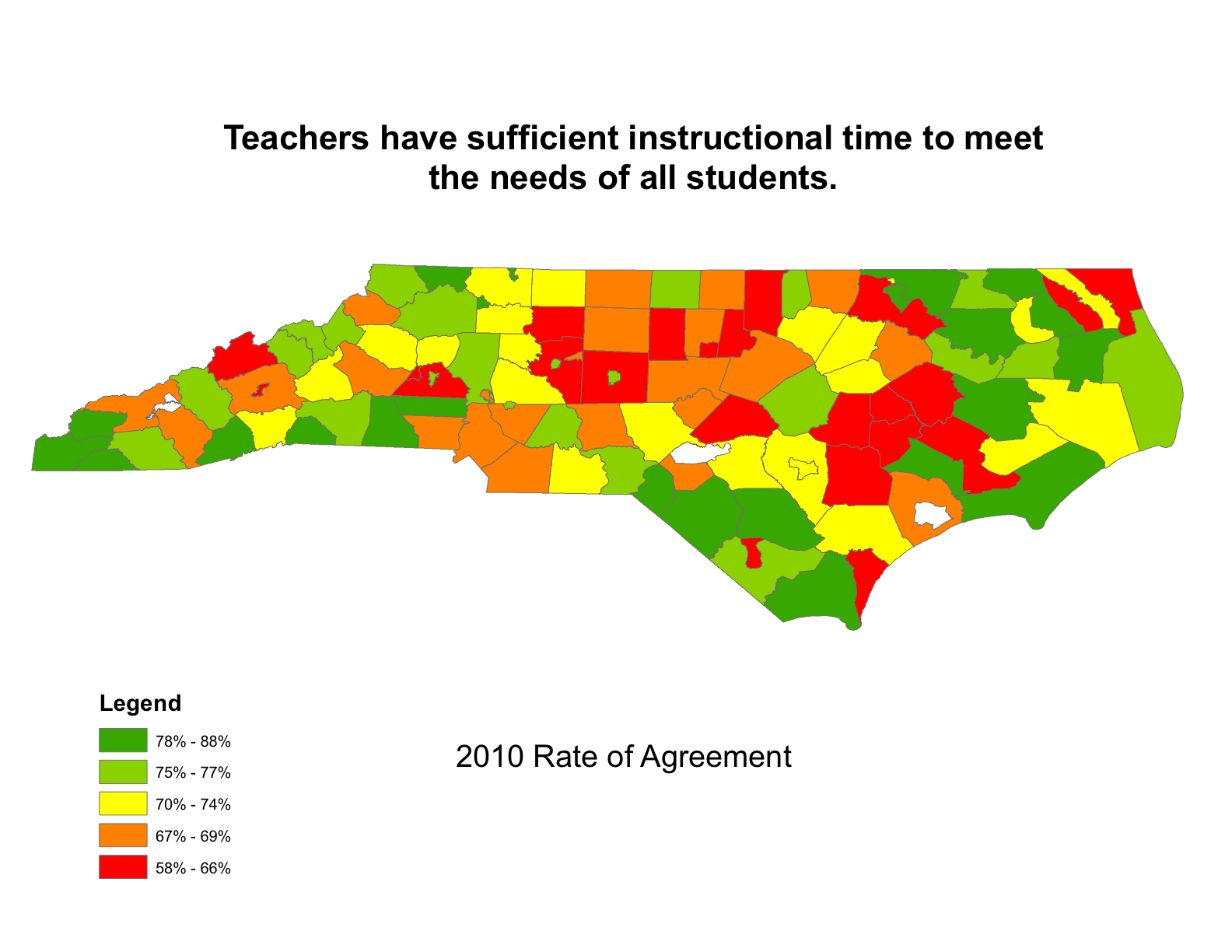
    Working conditions: a glimpse of future data

    That's North Carolina rather than Kentucky, of course, offering a quick glimpse of information they've gathered on teacher working conditions for years.  There are ten more maps like that one here, and then there are amazingly detailed school-by-school reports like this one.

    At today's meeting of the Teacher Effectiveness Steering Committee, we started thinking about how to develop a Kentucky version of a similar survey, starting with a coalition of stakeholders defining key issues to include.  There are some exciting possibilities headed our way!

    Hat tip: Commissioner Holliday's Facebook update on the subject.

    Sunday, June 13, 2010

    Essential KBE discussion: councils, standards, demographics, and doing what's right

    After Robert Frost Middle School was identified as one of the state's persistently lowest performing schools, a state leadership audit reported that the Frost school council lacked the capacity to lead the needed turnaround.  In appealing that finding, the Frost council pointed out that Jefferson County had rated them as having the highest level of efficiency three years in a row.

    At last week's Kentucky Board of Education meeting, KBE member David Karem asked Commissioner Terry Holliday to explain the disconnect that allowed the state team to see such weakness where the district had seen strength. Here's the discussion that followed:
    TERRY HOLLIDAY: Well let’s cut to the chase.

    DAVID KAREM: Okay, help me.

    TERRY HOLLIDAY: You guys hired me to be honest with you, I’m going to be honest with you.

    As I understand it (Sally you correct me if I’m misstating here), ever since we’ve had site-based councils, Jefferson County has owned their training and support and coaching for site-based councils. They have not utilized state services for that purpose, and they’ve had their own standards for site-based councils.

    Our standards focus much more on these proven standards of school improvement that are very much aligned with accreditation for Southern Association and Advanced Ed. A huge difference is our focus on student achievement.

    If we look at the thirty-two lowest achieving schools in Kentucky, twenty-two of them are in Jefferson County. We also have to look at the demographics of Jefferson County. I applaud the superintendent for their work on trying to balance schools there. because if you have a tremendous population of poverty and at-risk kids, it’s difficult.

    So we looked at two different things, David, that’s the bottom line.

    DAVID KAREM: It seems then that from the point of view of the state board of education and the commissioner that we should communicate to Jefferson County that it would be helpful in the future if we had an integrated dialogue that would suggest that we’re looking at the same kinds of standards.

    The numbers are the numbers, which suggest that we should be supporting your finding, which I do, but I would also suggest that we ought to be communicating to Jefferson county that we ought to have this integration, that’s a polite way to say it.

    And I am (maybe I won’t be safe in going back to Jefferson County today in saying this) but I’m exhausted with people saying that the demographics of the student population are so horrific (I mean I guess that’s the only word I can come up with) that we get a forgiveness for not doing what’s right for the students. I mean, it just drives me up a wall.

    As I understand it (and Terry you can correct me)...we have examples in the state of Kentucky where there’s one school district that has hideous demographics if that’s what you want to call it, and we have another with the same hideous demographics, and the one school district has decided to gird its loins and do the right thing and they’re successful. That just drives me up a wall.
    Jefferson County has long operated as its own jurisdiction, but this discussion definitely sounded as though Kentucky expectations will indeed be applied to its future work.  On behalf of the Kentucky children living in Jefferson County, I certainly hope that proves to be the case.

    Source note: I transcribed the dialogue above from this webcast, with this portion coming about an hour and 55 minutes into the morning deliberations.

    Saturday, June 12, 2010

    Summer Newsletter is a feast!

    The Summer issue of  Prichard Perspectives is now available on-line, with an irresistable menu of news on education issues and the Committee's efforts:
    • Wilhoit says U.S. schools need to make big changes
    • Pilot program makes math a ‘productive struggle’ (with details on the Gates math work)
    • Pew grant extends Prichard Pre-K work
    • Brant promoting Pre-K business leadership council
    • Pre-K expansion bill dies in legislature
    • Policy Center sees Kentucky students rising
    • Harvard report spotlights Commonwealth Institute
    • [Missing Piece] Workshops spread across Kentucky
    • [Authentic Parent Engagement] Workshop will equip parent-leadership trainers
    • Moberly honored with Award of Excellence
    • Sexton addresses Bellarmine grads
    • Heine joins meeting with Duncan
    • Privett to join Prichard work
    • Sexton, staff share Prichard lessons in Baltimore
    • Walter Baker dies; former lawmaker, Prichard member

    Enjoy it all here, and don't miss the lovely reminders that you can support the Committee's work with a donation, and honor educators who have made a difference in your life.

    More technology tidbits: blog subscriptions and Moodle

    Blogs by e-mail (especially this one)(hint, hint)
    If you're a regular with e-mail and would rather read the news there, most blogs offer a subscription option.  When you're reading the blog, check around the right or left margin, and you'll almost certainly find the link.  If you'd like to subscribe to the Prichard Blog, just click here and enter your e-mail address.

    Since I credited my kids in the earlier post, I'll credit this one to my long-lost twin, Lu Young, who shares my exact birthday and mentioned recently that it was a big help to see her teachers' Moodle discussions show up in her e-mail inbox.  Aha, I thought! The way to sneak up on busy superintendents is through their e-mails, not their internet browsers.  For all our other busy readers, we'd love to have you as subscribers, too.

    Moodle?
    I don't use use this one yet, but I know enough to share the basics.  Moodle is an on-line system that lets educators manage their classes, complete with syllabus, readings, on-line quizzes, and internet discussions. The college professor I know best uses Moodle and his teaching and grading work are now just about paper-free. You can read more about it here and here.

    Technology tidbits: getting smaller addresses and more efficient news

    Having three people between 15 and 25 in the house is a major enhancement to my cyber-skills.  Here are some things I've learned that way.

    Tiny Urls
    Want to send someone the link to a website--but finding the address (the url)  impossibly long?  To shrink it, copy the whole address and go to tinyurl.com.  With a couple of keystrokes, www.education.ky.gov/KDE/HomePageRepository/News+Room/Current+Press+Releases+and+Advisories/10-030.htm can become tinyurl.com/KBEJune.

    Really Simple Syndication for occasional blog-reading
    If you regularly check on blogs and other sites with frequent updates, you've probably seen the orange RSS icon (usually much smaller than the illustration to the right, with the name being short for "really simple syndication").

    When you're on a page you visit often, click that icon, and you'll get easy steps to create up a link that shows you the updates on a regular basis.

    Goog/e Reader for constant blog-reading
    As this blog probably proves,  I've been going to many websites many times each day.  Using RSS feeds isn't enough to make that quick work.  Instead, I've moved to Google Reader.

    The account is super-simple to create, and free.  If you already have a Google account (or blogger or gmail acount), you can use the same sign-in.  Otherwise, you can set up an account in less than a minute.

    Next, you go to each site you want to read regularly, click that RSS icon, and copy the address into the "add a subscription" space on Google Reader. 

    When that's done, you can go to your Google Reader any time, and find all the new articles and posts from all your chosen sites.

    For example, I get up in the morning and click one link to see everything new from Richard Day, Commissioner Holliday, EdWeek's Politics P-12, the Herald-Leader education page, the Courier-Journal opinion page, and 26 other sites.

    I'm still an addict, but the software makes my habit much easier to feed.

    Friday, June 11, 2010

    Kentucky degree ranking gets some attention

    Huffington Post has just picked up on valuable April reporting by the Chronicle of Higher Education about state levels of higher education among young adults 25 to 34.  The main map looks like this, and you can click states to get details if you go the version here.
    The Association of Independent Kentucky Colleges and Universities earns a hat tip for spotting this coverage.  Kentucky's position of 38th made it one of the states that HuffPo included in its picture display of weakest state, and AIKCU rightly tweeted that this is "not a list to be proud of."

    Note to number lovers: I haven't found the Chronicle's backup information for the map, but the figures are sure to combine two-year and four-year degrees.  When you click Kentucky on the map, you see  32.2 percent as the college degree figure, where as my most recent reporting from census numbers was 22.8 percent with bachelor's degrees. 

    Wednesday, June 9, 2010

    A grim seven percent cut for our youngest students

    Kentucky preschoolers are about to lose some important financial support.  Enrollment is rising while state funding is declining.  As a result, the Kentucky Board of Education today accepted dollar figures for next year that will be a major step backward in state support for each preschool student:
    Next time someone tells you state funding for education has been preserved, tell them about the at-risk four-year-olds from low-income families and the three-and-four-year-olds with disabilities who need a strong start on their futures--and whose chances will be weakened next year.

    K-8 critical areas in the mathematics standards

    The Common Core Standards for Mathematics include detailed expectations for each grade level on the way to students being ready for success in college and on the job. As a parent, one of my favorite elements comes on the opening page for each grade, where the first paragraph lays out the critical areas for instruction each year. Here's the full list:

    KINDERGARTEN
    (1) Representing and comparing whole numbers, initially with sets of objects
    (2) Describing shapes and space

    GRADE 1
    (1) Developing understanding of addition, subtraction, and strategies for addition and subtraction within 20
    (2) Developing understanding of whole number relationships and place value, including grouping in tens and ones
    (3) Developing understanding of linear measurement and measuring lengths as iterating length units
    (4) Reasoning about attributes of, and composing and decomposing geometric shapes

    GRADE 2
    (1) Extending understanding of base-ten notation
    (2) Building fluency with addition and subtraction
    (3) Using standard units of measure
    (4) Describing and analyzing shapes

    GRADE 3
    (1) Developing understanding of multiplication and division and strategies for multiplication and division within 100
    (2) Developing understanding of fractions, especially unit fractions
    (fractions with numerator 1)
    (3) Developing understanding of the structure of rectangular arrays and of area
    (4) Describing and analyzing two-dimensional shapes

    GRADE 4
    (1) Developing understanding and fluency with multi-digit multiplication, and developing understanding of dividing to find quotients involving multi-digit dividends
    (2) Developing an understanding of fraction equivalence, addition and subtraction of fractions with like denominators, and multiplication of fractions by whole numbers
    (3) Understanding that geometric figures can be analyzed and classified based on their properties, such as having parallel sides, perpendicular sides, particular angle measures, and symmetry


    GRADE 5
    (1) Developing fluency with addition and subtraction of fractions, and developing understanding of the multiplication of fractions and of division of fractions in limited cases (Unit fractions divided by whole numbers and whole numbers divided by unit fractions)
    (2) Extending division to 2-digit divisors, integrating decimal fractions into the place value system and developing understanding of operations with decimals to hundredths, and developing fluency with whole number and decimal operations
    (3) Developing understanding of volume


    GRADE 6
    (1) Connecting ratio and rate to whole number multiplication and division and using concepts of ratio and rate to solve problems
    (2) Completing understanding of division of fractions and extending the notion of number to the system of rational numbers, which includes negative numbers
    (3) Writing, interpreting, and using expressions and equations
    (4) Developing understanding of statistical thinking


    GRADE 7
    (1) Developing understanding of and applying proportional relationships
    (2) Developing understanding of operations with rational numbers and working with expressions and linear equations
    (3) Solving problems involving scale drawings and informal geometric constructions, and working with two- and three-dimensional shapes to solve problems involving area, surface area, and volume
    (4) Drawing inferences about populations based on samples


    GRADE 8
    (1) Formulating and reasoning about expressions and equations, including modeling an association in bivariate data with a linear equation, and solving linear equations and systems of linear equations
    (2) Grasping the concept of a function and using functions to describe quantitative relationships
    (3) Analyzing two- and three-dimensional space and figures using distance, angle, similarity, and congruence, and understanding and applying the Pythagorean Theorem

    The boy (almost) next door goes for glory!

    Ralph Morrison, of Danville High School's  Class of 2006, was also Williams College's Phi Beta Kappa Speaker at their 2010 graduation. 

    Tuesday, June 8, 2010

    C-J notes the education cuts

    In the Courier-Journal, Tom Loftus reports on the major losses in key state services under the new budget, with this key information:
    And education -- perhaps the state's top priority -- also is taking significant cuts.

    Universities will get about 9 percent less in 2012 than the amount originally appropriated for 2008. And, while the base funding program for public schools -- known as Support Education Excellence in Kentucky, or SEEK -- has held about even, some important support programs for the schools have been slashed.

    "These programs to help schools improve are as important as SEEK, if not more important," said Robert Sexton, executive director of the Prichard Committee for Academic Excellence. "Holding SEEK funding level has become an easy way to say, 'We're not cutting education.' But it's deceptive."

    For language, against slashing punctuation

    "Common Core State Standards for English Language Arts & Literacy in History/Social Studies, Science, and Technical Subjects" is the official title of the document discussed in the previous post.  Given my overall enthusiasm, you might well ask whether there's a single key stroke I don't like.  The answer is yes.  I despise that slash mark between history and social studies.

    I want my punctuation marks to flow smoothly into speech. Commas and periods and question marks all adjust how words are pronounced, without needing to be named. The written ampersand easily becomes the spoken "and."  A slash mark doesn't work that way. To read it out loud, a person has to say "slash."  

    More than that, the slash mark is a dodge.  It fails to explain how the words on either side go together.  Are they a pair that belong together?  Are they alternatives that should be used separately? Writers who use slash marks look to me like thinkers who have not yet finished thinking.

    Here, I suspect a compromise.  Some advocates push for making history  the lead subject, with civics, economics, and geography as back-up singers.  Others insist that social studies is an effective way of combining multiple fields that deserve equal standing.  The  slash mark looks like splitting the difference between the two approaches, perhaps avoiding a huge battle and a long delay.

    Even so, it's ugly writing, incomplete thinking, and an approach to language unlikely to be used outside of quotation marks on this blog.

    Reading for academic content!

    The common core standards call for important new attention to the skills needed for successful reading in  history, social studies, science and technology.

    All the reading sections start from ten college and career readiness anchor standards. We see those ten in K-5 literary reading, K-5 informational reading, and 6-12 English language arts reading, each time broken out into grade-by-grade versions of what students need to master on the way to being fully prepared by the end of high school. 

    For selected subjects, each of the ten anchor standards appear again,with a small twist to focus on the specific kinds of understanding needed for those subjects.

    For example, anchor standard 3 calls for students to: "Analyze how and why individuals, events, or ideas develop and interact over the course of a text."

    That's broken out for history and social studies by expecting students to:
    • "Identify key steps in a text’s description of a process related to history/social studies (e.g., how a bill becomes law, how interest rates are raised or lowered)" in grades 6, 7, and 8.
    • "Analyze in detail a series of events described in a text; determine whether earlier events caused later ones or simply preceded them" in grades 9 and 10.
    • "Evaluate various explanations for actions or events and determine which explanation best accords with textual evidence, acknowledging where the text leaves matters uncertain" in grades 11 and 12.
    For science and technical subjects, the grade-level versions ask students to:
    • "Follow precisely a multistep procedure when carrying out experiments, taking measurements, or performing technical tasks" in grades 6, 7, and 8.
    • "Follow precisely a complex multistep procedure when carrying out experiments, taking
    • measurements, or performing technical tasks attending to special cases or exceptions defined in the text" in grades 9 and 10.
    • "Follow precisely a complex multistep procedure when carrying out experiments, taking
    • measurements, or performing technical tasks; analyze the specific results based on explanations in the text" in grades 11 and 12.
    Overall, the reading standards push for students to work with complex texts at a much higher level than is common in most American schools now.  To reach that level of skill, they'll need ongoing instruction and ongoing practice across the middle and high school curriculum--and the common core gives a clear vision of how that can happen in a set of major academic subjects.

    Saturday, June 5, 2010

    Shakespeare! In the Standards!

    The new Common Core standards expect that grade 11 and 12 students will
    Determine the meaning of words and phrases as they are used in the text, including figurative and connotative meanings; analyze the impact of specific word choices on meaning and tone, including words with multiple meanings or language that is particularly fresh, engaging, or beautiful. (Include Shakespeare as well as other authors.)
    and also
    Analyze multiple interpretations of a story, drama, or poem (e.g., recorded or live production of a play or recorded novel or poetry), evaluating how each version interprets the source text. (Include at least one play by Shakespeare and one play by an American dramatist.)
    The Reading Standards for Literature do mention other works as examples that could be replaced by other examples:
    Analyze how a modern work of fiction draws on themes, patterns of events, or character types from myths, traditional stories, or religious works such as the Bible, including describing how the material is rendered new. (Grade 8)
    Analyze the representation of a subject or a key scene in two different artistic mediums, including what is emphasized or absent in each treatment (e.g., Auden’s “Musée des Beaux Arts” and Breughel’s Landscape with the Fall of Icarus). (Grade 9)
    Analyze how an author draws on and transforms source material in a specific work (e.g., how Shakespeare treats a theme or topic from Ovid or the Bible or how a later author draws on a play by Shakespeare). (Grade 9)
    The Bard, though, is not an example.  He's identified as an author--the author--students must meet.  That uniqueness is, I think, quite right.  Shakespeare's contribution of language, images, characters, and plots is entirely unequaled in English, and and the scale of his work is unmatched in any other language.

    (Hat tip to the New York Times: I missed this important new element in my first quick skim of the standards documents.)

    Thursday, June 3, 2010

    Common core raises the bar on evidence in student arguments

    The multi-state Common Core standards (soon to be known also as the Kentucky Core Academic Standards) come with a new built-in expectation about student thinking.

    First, the literacy document lists eight overall capacities of "students who are college and career ready in reading, writing, speaking, listening, and language."  The sixth item on the list is that:
    They value evidence.  Students cite specific evidence when offering an oral or written interpretation of a text. They use relevant evidence when supporting their own points in writing and speaking, making their reasoning clear to the reader or listener, and they constructively evaluate others’ use of evidence.
    Then, in the thirty-two anchor standards elaborating what makes a student college-and-career-ready, I count six references to evidence used in argument:
    • Read closely to determine what the text says explicitly and to make logical inferences from it; cite specific textual evidence when writing or speaking to support conclusions drawn from the text. (Reading 1)
    • Delineate and evaluate the argument and specific claims in a text, including the validity of the reasoning as well as the relevance and sufficiency of the evidence. (Reading 8)
    • Write arguments to support claims in an analysis of substantive topics or texts, using valid reasoning and relevant and sufficient evidence. (Writing 1)
    • Draw evidence from literary or informational texts to support analysis, reflection, and research. (Writing 9)
    • Evaluate a speaker’s point of view, reasoning, and use of evidence and rhetoric. (Speaking & Listening 3)
    • Present information, findings, and supporting evidence such that listeners can follow the line of reasoning and the organization, development, and style are appropriate to task, purpose, and audience. (Speaking & Listening 4)
    Even that list is probably too short, because additional anchor standards look for related things like analysis of supporting details and development of main ideas.

    Finally, there are grade-by-grade standards showing the steps by which students should climb toward meeting the college-and-career-ready anchors.  Evidence to support arguments again gets steady emphasis. The kindergarten versions are very simple things, but even at that level, students should "With prompting and support, describe the connection between two individuals, events, ideas, or pieces of information in a text." and "With prompting and support, identify the reasons an author gives to support points in a text."

    Is ability to use evidence and build arguments and explanations important for college success?  Certainly.

    Will that capacity be useful in most jobs--and nearly all jobs that can support a family?  Definitely.

    Will our communities and our state be stronger if our future citizens are well-prepared for this sort of engagement?  No doubt about it.

    Do we have our work cut out for us?  Yes, we surely do.

    City leaders: common standards and "a real shot at the American dream"

    We believe it is only through common standards that we can deliver on the promise of equity implicit in the purpose of public education, and give all our young people a real shot at the American dream.
    So argue 55 members of the Council of Great City Schools in an open letter urging states to adopt and implement the new common core standards. Shelley Berman of Jefferson County is a signatory, along with the superintendents from Albuquerque, Anchorage, Atlanta, Baltimore, Birmingham, Boston, Buffalo, Charleston County, Charlotte-Mecklenburg, Chicago, Cincinnati, Clark County, Cleveland, Columbus, Dallas, Dayton, Denver, District of Columbia, Duval County, East Baton Rouge, Fort Worth, Fresno, Hillsborough County, Houston, Indianapolis, Jackson, Kansas City, Little Rock, Long Beach, Los Angeles, Memphis, Miami-Dade, Milwaukee, Minneapolis, New York City, Newark, Norfolk, Oakland, Oklahoma City, Omaha, Orange County, Philadelphia, Pittsburgh, Portland, Providence, Richmond, Rochester, Salt Lake City, San Diego, San Francisco, Seattle, St. Louis, St. Paul, and Toledo.

    Here's the core of their argument:
    In the absence of a clear and consistent set of common academic standards for what should be expected of all children, each state instead sets its own standards for what kids should know and be able to do. Sometimes these standards are high; often they are not. Either way, the inconsistencies between them serve to perpetuate the nation’s educational inequities at a time when we should be working to overcome them. This issue is particularly important in America’s largest cities, which educate millions of the students the nation most desperately wants to help. With proper support for implementation, the Common Core State Standards will help us solve these problems.

    These standards will help us ensure that high school graduates across the country are adequately prepared to compete in the global economy, no matter which state they come from. These standards will give all our schools common targets, clarifying what we expect teachers to be teaching and what we will hold schools and districts accountable for. These standards will give us, for once, a common definition of what academic proficiency means and what it doesn’t mean, rather than having 50 different definitions. Not only will this help schools focus their efforts on one set of high standards, it will undercut the temptation by individual states to lower their standards or dumb down their tests to meet federal targets.

    Wednesday, June 2, 2010

    They're here!

    The common core standards are ready now!

    Click here for literacy or here for math.

    Plus, check out the supporting information on the common core website! 

    (I'll have more thoughts later, of course.)

    Tuesday, June 1, 2010

    They say down, I say up: Two takes on graduations

    "Data from the 2008-09 school year show that Kentucky's public school students had slightly lower graduation rates than those in the 2007-08 school year," says the Department's press release, so I should explain a bit more about my upbeat post earlier today.

    The main difference comes from different counts of students who should have graduated each year:
    The Department sums up students who collected diplomas or certificates and then adds the number who dropped out of that class over four years.  That is a respected method, but comparing the resulting total to the eighth graders who participated in spring testing four years earlier shows a big difference.  I think the eighth grade count gives a better idea of how many should have graduated.  And yet, notice that the Department's count showed faster one-year growth.  Dividing by that bigger 2009 number is main reason KDE found a smaller graduation percentage.

    There's also a difference in counting total graduates that looks like this:
    Again, the Department used the first number, and I used the second.  The Department approach matches a common practice of wanting to know mainly about graduation in four years, and then adding in students whose disability justified the added time needed to earn a diploma.   That leaves out students who take more than four years to graduate without an IEP to explain the delay.   Dissenting, I value  every young adult who has earned a diploma equally. On this issue, the count I used grew faster than the one the Department's version.  

    Combining the two results, the Department took a slower-growing graduate count and divided it by a faster growing potential-graduate count--and the result showed 2009 results as weaker than 2008.  I saw more graduate growth and less potential growth--and my results showed 2009 as stronger than the year before.

    Note to the frustrated: Would it be better to divide graduates by the number of students who started grade nine four years earlier?  Yes, of course.  Doing it that way, though, depends on a student data system that assigns each student a unique identification number and then tracks each one, including each one who moves to a different school.  We've been talking about that approach at least since 1999, but we didn't get it fully launched until the fall of 2009.  It will take four years for that system to track its first ninth grade through to graduation, and then debates like this can finally come to a close.

    Graduation improves, mysteries shrink but continue

    In 2009, Kentucky again awarded more public high school diplomas than the previous year, continuing a steady pattern of recent growth. 41,820 students graduated, marking 2.5 percent growth since 2008 and 12.0 percent growth since 2004.

    Also, I like what I see when I compare those numbers to the number of students who participated in eighth grade testing four years earlier.   The graduates are a growing percent of the students tested--81.5 percent compared to 80.8 percent last year and 78.7 percent five years ago.  Certificates of completion have also grown. Dropouts during the high school years are unchanged from 2008 but notably improved from 2004.
    Finally, the mystery group is shrinking. When I add up diplomas, certificates, and dropouts, they still don't add up to the eighth grade testing number, but the missing group is a smaller share of the total: 2,400 in 2009 compared to 3,061 last year and 2,652 in 2004.

    Notes for number lovers: I use the testing count because I trust it.  It would be very hard for districts to under-count students on the first day of testing, and essentially impossible for them to over-count the number of testing booklets students complete. I use grade eight because it's a late spring count of students who are likely to become first-time ninth-graders the next year. In a state that has historically been unable to separate students who have just begun grade nine from students repeating that year, it's the closest I've been able to get to the number of students we should want to see walking across the stage four years later.  By all reports, Kentucky is now using a student data system that will solve this problem, marking students who entered ninth grade in the fall of 2009 and planning to track them through to graduation accurately.


    Notes for those who want to see the original reports:  The Department's newest reports are here, and include numbers for each district.   From those files, the numbers I used for the calculations above are shown below. 

    Saturday, May 29, 2010

    The cult of the library (with a bit of cultural literacy on the side)

    Mostly, this is good fun for a Saturday post.

    Still, I'm compelled to admit that in the original movie, I sighed with happiness at the site of the library lions and gasped in horror when the ghosts attacked the card catalog? Watching this one, I'm realizing that I find scenes shot in libraries nearly as riveting as those that feature George Clooney. 


    (If the film doesn't load for you, it's also available at tinyurl.com/readngroom)

    Thursday, May 27, 2010

    KCTCS graduation rates and Pell grants

    For full-time, first-time students, here's a comparison table for the Kentucky Community and Technical System's schools.  
    Pell grants go to students from low-income families. 

    Jefferson has the smallest proportion of students needing Pell grants and the smallest proportion of students completing associate's degrees in three years. 

    Bowling Green, the school with the highest graduation rate, has 19 percent more Pell recipients.

    Southeast, the school with the highest Pell participation of all, has 24 percent more graduates.

    I'm new to these numbers and will welcome any discussion of what's behind these patterns and other elements of the data.

    Source note:  The information in the chart comes from the College Navigator offered by the National Center for Education Statistics.

    Slow blogging ahead

    Molly has finished her last college paper, her last written exam, and her last oral. 

    She'll be home for the summer, improving civic websites and encouraging her dad to make his "coffee house and public life" course into a book.

    After that, destiny beckons--the one obvious when she wanted to "hold the books" in her first year of primary, vivid when her fourth-grade portfolio entries were passed from hand to hand in the House education committee meeting, unmissable when she started explaining what "blogs" were in the wake of the 2000 election.  Yes, of course, my first-born is headed to law school.

    But before all that, there's celebration to be done.  We'll be on the road early tomorrow, and posting wil be light or non-existent until next Tuesday.

    Tuesday, May 25, 2010

    PD networks endangered by House cuts?

    The current House budget bill provides $5,189,600 for highly skilled educators in fiscal year 2011, and $0 in fiscal year 2012.

    Highly skilled educators are the Department's key agents for transforming our weakest schools. They've been successful in most schools that have needed assistance--leaving the smaller group of "persistently low performing" that seem to need a new set of strategies.

    With new federal school improvement grants on the way, legislators might argue that highly skilled educators are no longer a priority for tight state funding.

    It's not going to be that easy.

    The Department has already taken the federal support into account, and made plans to refocus equipping schools to meet Kentucky's new college-and-career-ready standards. For the new professional development networks, the promised regional specialists in literacy and mathematics are supposed to funded out of the HSE budget.

    At a legislative hearing two weeks ago, Commissioner Holliday explained his plan by noting that all schools are expected be low-performing against those higher expectations. Since the HSE mission is to assist weak schools, he argued that using those folks to tackle the standards was a legally respectable way to fund essential work.

    If the HSE money also disappears, that plan can only work for the coming year, getting the networks off the ground with work on understanding and breaking down the new standards for classroom work. After the basics on the standards, though the networks are expected to spend two more years building statewide capacity to use formative assessments and other data to shape instruction. Without the HSE/specialists, that work will be close to impossible.

    We know that tracking students and adjusting instruction based on individual results is what works to raise achievement and close gaps.

    We know that for two decades teachers have wanted systematic support to become proficient at that core strategy.

    We know that in Senate Bill 1, the legislature mandated that the Department finally, seriously, find the ways to meet the need.

    We know that the Commissioner, in the face of budget devastation, had to dig deep to find any funding he could move to do what SB 1 requires, what teachers say is urgently needed, and research says will work for our students.

    The HSE budget is the available funding for the most important undone work in all of Kentucky education. Are we really about to take that away?

    Monday, May 24, 2010

    Walter Baker

    Walter Baker, former state senator and member of the state Supreme Court, one of the creators and key Republican supporters of the Kentucky Education Reform Act of 1990, has left us.  The Herald-Leader shares words from Judge Sara Combs that I can second from direct experience: "He was a great gentleman, a historian, a scholar and just consummately kind."

    177 instructional days, one of them unfunded

    Here's the language from the new House Bill 1:
    Notwithstanding KRS 158.070, the school term for fiscal year 2010-2011 and fiscal year 2011-2012 shall include the equivalent of 177 six-hour instructional days. Districts may exceed 177 six-hour instructional days. Included in the above General Fund appropriation are sufficient funds for 176 six-hour instructional days.
    So, if districts must provide 177 days with funding sufficient for 176, how will the last day be funded?

    In a nutshell, the options are taking money from reserves, collecting added revenue from local taxpayers, or cutting some portion of current local budgets.

    What is House A&R saying? (SEEK base funding)

    The current House budget bill provides for an increase (a very small increase) in the SEEK base guarantee per pupil and a decrease (not such a small increase) in the state funding that pays that increase. The numbers look like this:
    The state share of the SEEK base can be decreased because the local share is expected to go up yet again.

    Here come the cuts (House budget bill)

    The special legislative session began today. Under the budget bill filed today in the House, P-12 education will receive significantly less state funding next year. Comparing the budget for FY 2011 to the original budget for 2010, the largest reductions are:
    • $62.7 million from base SEEK funding
    • $21.0 million from textbooks
    • $12.8 million from teachers' retirement premiums for current teachers
    • $9.6 million from the Facilities Construction Commission
    • $3.7 million from early reading grants
    • $2.6 million from preschool
    • $2.5 million from family resource and youth service centers
    • $2.1 million from education technology
    • $1.3 million from the Professional Standards Board
    • $1.2 million from mathematics achievement
    There are some increases, including:
    • $31.2 million to health insurance for school and district employees
    • $18.2 million to maintain benefits to retired educators
    • $7.9 million to facilities equalization
    • $2.8 million to Tier I SEEK funding
    Overall, P-12 funding will decrease by $62.7 million if the current House budget bill takes effect. Of course, changes are possible as the bill moves from committee to the House floor, from there to the Senate, and quite possibly back again to resolve differences.

    Note for number lovers: The facilities equalization increase above includes the line items for the Facilities Support Program of Kentucky (FSPK), equalized facility funding, growth levy equalization, and retroactive equalized facility funding. The total decrease included the budgets for the Department of Education, the Education Professional Standards Board, the School Facilities Construction Commission, and the line item to maintain benefits for educators who have already retired.

    Sunday, May 23, 2010

    "We are better off for having one another"

    There's the phrase I wanted for the Brown v. Board anniversary. It says it all, even without context.

    But then, the context is worth a moment. I'm cooking brunch this morning for Katie Moore and Sarah Hargis and their families, to celebrate their Centre graduations this morning and the teaching careers they'll start this fall.

    With the radio on, I was only half listening to (of all things) the international sports news.  To get the wording right,  I hunted up the story online, and here are the basics:
    Archbishop Desmond Tutu says the decision by the Bulls to play their Super 14 rugby semi-final in Soweto is the “most important development in the sport since the Springboks won the World Cup in 1995”.

    Tutu, the anti-apartheid campaigner and Nobel Peace Prize winner, said all South Africans should applaud the move by the Pretoria-based Bulls to play today’s match in the famous township, which was home to more than one million people, mainly poor blacks.

    “It is one of those special South African moments that proves we are better off for having one another, and that despite the challenges we face, our society is on the right track,” said Tutu.

    It’s a landmark move by the Bulls, whose supporters are generally whites, to play in Soweto – the township synonymous with black resistance to apartheid. It’s the first major rugby match to be held in a township.

    “Not too long ago,” Tutu said, “Pretorians may have choked on their moustaches at the thought of kicking for posts at Orlando Stadium, Soweto. And the arrival of these giant Bulls from the north would have sent Sowetans ducking for cover.

    “But this weekend Soweto will host the biggest rugby match ever held in a South African township.”

    The Bulls chose to play in Soweto after handing over their Loftus Versfeld stadium to soccer World Cup organisers last week.

    Saturday, May 22, 2010

    Degrees grow again!

    Kentucky public higher eduction has again increased the number of students receiving associate and baccalaureate degrees, according to the preliminary report on graduations for the 2010 academic year from the Council on Postsecondary Education.

    Compared to 2009, associates degrees are up 10.9 percent and baccalaureate degrees up 6.4 percent.

    Compared to 2000, the associate increase is 89.2 percent and and baccalaureate growth 34.6 percent.

    Here are the overall numbers, followed by the breakdown of each university's number of bachelor's degrees:


    Friday, May 21, 2010

    RTTT is still in reach

    Charter schools are not on the agenda for the special legislative session, and that means it's time to get the Race to the Top competition in proportion.  Word is that eight to ten states will likely receive grants in round two.

    Kentucky's round one score put us ninth overall and seventh among states that did not win that time.  All states are working on strengthening their applications, and some could surge past us.

    Still, please do remember that we are improving all the small weaknesses in our application, and know that there is serious work underway to make our evaluation section clearer and stronger.

    A charter bill, even a weak one, could make us a shoe-in.  Even without it, though, we're still in the running.

    Jefferson reading ahead of urban districts, behind state and nation

    In 2009, Jefferson County joined the Trial Urban District Assessment in reading.  In that program, NAEP produces district level scores as well as state and national results, and NAEP also reports scores for large cities as a group. 
    In both fourth and eighth grade, Jefferson County students are reading at higher levels than the average for urban students, but below the average for Kentucky students.  In eighth grade, Jefferson results are also below the national average.  In fourth grade, Jefferson is statistically tied with the national results.

    The full report, including disaggregated results for by ethnicity and family income, is here.  Because 2009 was the first year Jefferson County participated, the report cannot say whether reading skills have improved over past years.

    Tuesday, May 18, 2010

    "Look up and out and into your sister's eyes" (Brown anniversary)

    For this Brown v. Board anniversary, Secretary Duncan's prose statement of the moral commitment is here and important, but I find myself wanting poetry.  I want words for the joy of sharing and building one community, embodied most of all in our common schools and the work we do there for all our children.  Maya Angelou's got what I need:
    You, the Turk, the Swede, the German, the Scot ...
    You the Ashanti, the Yoruba, the Kru, bought
    Sold, stolen, arriving on a nightmare
    Praying for a dream.

    Here, root yourselves beside me.

    I am the Tree planted by the River,
    Which will not be moved.

    I, the Rock, I the River, I the Tree
    I am yours--your Passages have been paid.

    Lift up your faces, you have a piercing need
    For this bright morning dawning for you.

    History, despite its wrenching pain,
    Cannot be unlived, and if faced
    With courage, need not be lived again.

    Lift up your eyes upon
    The day breaking for you.

    Give birth again
    To the dream
    The full poem is here, ending with that perfect summary of the true delight of being/becoming an indivisible nation:
    Here on the pulse of this new day
    You may have the grace to look up and out
    And into your sister's eyes, into
    Your brother's face, your country
    And say simply
    Very simply
    With hope
    Good morning. 

    Sunday, May 16, 2010

    Completely local, completely optional (Commissioner Holliday's charter bill)

    Imagine that Commissioner Holliday's suggested charter legislation becomes law.

    How will charters be formed?

    First, someone must decide to apply.  That could be a group of parents, or teachers, or a combination.  It could be a company from out-of-state. So far,

    Next, they'll complete a huge application.   They'll need to describe their school: its mission, its curriculum, its instructional approach.  They'll explain who will be in charge: what kind of board or council or senate or whatever will make the key decisions.  They'll spell out policies on enrollment, discipline. and special education.  They'll set out how they'll ensure health, safety, transportation, and adequate facilities. They'll show a multi-year budget.  They'll explain how the school can operate without doing financial harm to the surrounding schools.  They'll specify how quickly achievement will rise, what consequences will apply if results fall short, and what steps will be taken if the school has to be shut down.

    Plus, the application will also have to show that they will do many things the same way as other schools.  Under the draft legislation, charters must give state accountability tests, meet state accountability goals for all students, and set and meet achievement gap targets for student subgroups.   They must employ certified teachers and principals, award tenure, and provide the health and retirement benefits that are standard for other educators.  They will not be able to discriminate in admissions, and they'll have to provide full special education services based on individual needs.

    Then, what happens to the application?

    The local board of education decides whether to grant the charter or not.

    The board sorts out whether the applicant has an idea that's well thought out, and the board sorts out whether the new approach would be a positive addition to local education.

    Elected local citizens, responsible for the well-being of the whole school system, decide whether the proposed charter should be allowed to open.

    Yes, the last three paragraphs say"local option" three different ways.  Here comes one more paragraph that makes the local option point even stronger.

    Once a local school board lets a charter open, the local school board can decide it needs to close. The  board can do that if the charter breaks a law, or doesn't fulfill one of its application promises, or  doesn't deliver the promised achievement.  The board can also simply decide that closing the charter is in the best interest of students.

    The proposal for Kentucky is not about outsiders forcing charters into a school district.  It's about setting up an option and letting local leaders decide whether to use that option.

    Sidebar for Jefferson and Fayette: The draft legislation also says that districts with magnet programs and parental choice of schools will not be required to form charters.   You can have charters in your districts, but only if your local board decides to allow them. It's a local option.  Of course, the point of this whole post is that charters will be a local option and a local choice everywhere in the state.  Saying they're optional for magnet-and-choice districts is redundant.  The idea is to reassure worried people in your territories one more time--but reading the whole bill shows that you don't really need that added round of protection.  Meanwhile, for those who think it might be interesting to try a charter school in Jefferson or Fayette, the draft bill will still allow that, using exactly the same process and requiring exactly the same work to show the local school board how the charter can be a positive contribution to local education.

    Saturday, May 15, 2010

    Common standards for multiple legacies

    Explaining why common core social studies standards may take more negotiation among the states, Commissioner Holliday pointed out that "there are people in South Carolina who still think the South won the Civil War." Our Commissioner is, of course, a native of the Palmetto state.

    I'm the daughter of Georgia parents, and my first thought was that the folks who think that way in the Peach State tend to call that conflict more simply "the War."

    That's not the heritage I claim.  I  call myself a "one-flag Southerner," and that flag is the Stars and Stripes.  I'm quite glad the United States won that war, openly impatient with people who even pretend they wish our Union had been sundered.  

    Still, I'm Southern enough that I see every part of American history as pivoting around the struggle between North and South and the damage slavery and its aftermath did to our economy, our culture, and our politics.

    That's not the only way to tell our story.

    Recently, I spent a Saturday morning studying the Indiana standards for U.S. History.  The Fordham Foundation ranks the Indiana work highly, and my hunch is that they'll play a shaping role in drafting the common core approach to that subject.

    What struck me first in reading the Indiana approach was that westward expansion loomed almost as large as slavery in their version of which 19th-century events should be well-known to 21st-century students. 

    Next, thinking about a recent visit to California and a family trip to New Mexico, I remembered that "westward expansion" is itself a loaded interpretation.  There's a way of telling those states' history that starts from Spain and Mexico, and joins other states by reaching east and north.  There's yet another way to tell the story that starts with being on this land long before Ponce de Leon and before John Smith and before the Pilgrims.  In that version, "we" met "everyone else" as they got off their boats from wherever they started.

    Weaving those threads into a single statement that works for people from many locations and legacies will not be a quick project.

    A shared version of social studies is going to require a kind of work that won't be needed for math or literacy or science.  Important work, good work, work worth doing, but hard work all the same.

    Friday, May 14, 2010

    Common core effort moving toward science, arts, history

    Mathematics and English/language arts are the first subjects being addressed by the Common Core State Standards Initiative, but they won't be the last. 

    Commissioner Holliday told a legislative committee today that a first draft of shared science standards may be available this summer from the National Research Council, though a final draft is many further steps away.

    He expects social studies standards will be developed, but that will be harder because of the national diversity of political opinions that have to fit together.  To underline the variety, he pointed out that there are people in South Carolina who still argue that the South won the Civil War.

    In separate news, the National Association of Music Educators reports that: 
    On May 11 and 12, the State Education Agency Directors of Arts Education (SEADEA) held a meeting of the National Arts Education Task Force to discuss the creation of common core standards in the arts. The meeting took place at the offices of the Council of Chief State School Officers (CCSSO) in Washington, DC.

    [snip]

    The group discussed what has changed in arts education since the national standards were released in 1994 and began developing an action plan to support the inclusion of the arts in the creation of the common core standards.
    For Kentucky, the one problem with this work is that it's slower than we need.  Senate Bill 1 calls for all our standards to be in place by this December, but the work with other states just is not moving at that pace.  Senator Winters today described efforts he's made and urged others to keep pushing for other states to accelerate the shared effort.  Yes, it's worth it to stick with the common effort, but it's also right for Kentucky to push for the common effort to work at maximum speed.

    Thursday, May 13, 2010

    Weakest schools: one-year limit on keeping a principal?

    In recent audits of Kentucky's weakest persistently low-performing schools, four principals were found to have the strengths needed to change their high schools.   Each report has been signed by the Commissioner and the district superintendent, and the superintendent sign-offs for Caverna, Shawnee, Western, and Leslie  County include this provision:
    Pending approval from the US Department of Education, the principal of [school name] may remain in this position for the 2010-11 school year.

    However, after one year of implementing the intervention plan, if [school name] has not made sufficient progress toward the annual goals and implementation of the intervention plan, the principal shall be removed.
    That one-year limit on keeping the principal does not appear in state law.  It was not part of House Bill 176, the intervention legislation that passed earlier this year to strengthen Kentucky's Race to the Top legislation.  There, it appears that audit approval will allow a principal to continue for many years into the future, even if the school continues to struggle.

    The one-year idea also does not come from the Race to the Top models.  There, the approach that requires replacing half the staff and the approach that specifies detailed transformation rules both say the principal must be replaced--and the other two options are closing the school completely or reopening under completely different management.   Keeping the principal isn't possible under any of those options.  The federal requirements for the School Improvement Grants use matching language and, again, do not allow any added time for a principal to lead the school's improvement.

    Reading those pieces, I'm puzzled.  Did KDE and USED work out a compromise, with an intervention approach that's more aggressive than Kentucky law but less aggressive than the federal grant rules? Is that where the "one more year" provision came from?   It looks that way, but I haven't yet found a source that confirms that sort of deal.

    Weakest schools: audit findings now public

    KDE has now posted the full reports from the audits of ten persistently low performing schools and the five districts that include those schools.  In those documents:
    • Six of ten principals were found to lack the capacity to lead the changes their schools will need.
    • Seven of nine councils were found lacking--and one had already been removed.
    • One of the five districts was found to lack the capacity to lead the needed changes.
    • The transformation option was recommended for four schools, and restaffing recommended for  five.  "Turnaround" was recommended for one, slightly puzzling since the relevant law does  not list that as one of the four possible interventions.
    Here's a chart showing the results for each school:

    Common core final on June 2?

    That's the word from EdWeek's Curriculum Matters blog, with no additional details in that post or at the website for the common standards initiative.