Tuesday, April 30, 2013

Reading for Key Ideas and Details (CCSS 1, 2, 3)

1. Read closely to determine what the text says explicitly and to make logical inferences from it; cite specific textual evidence when writing or speaking to support conclusions drawn from the text.  
2. Determine central ideas or themes of a text and analyze their development; summarize the key supporting details and ideas.  
3. Analyze how and why individuals, events, and ideas develop and interact over the course of a text.
In the Common Core State Standards (CCSS), the three sentences above are the first three reading standards.  More exactly, they are the college and career readiness anchor standards, defining what we want students to know and be able to do by the end of high school.

To reach those anchor standards, students will need to move up a ladder of standards specific to different grades and subjects, and Common Core also shows how the skills should develop over time.  For example, to meet the overall Standard 2, students should be able to
  • "Retell stories, including key details, and demonstrate understanding of their central message or lesson" in grade 1.
  • "Determine a theme of a story, drama, or poem from details in the text, including how characters in a story or drama respond to challenges or how the speaker in a poem reflects upon a topic; summarize the text" in grade 5.
  • "Determine the central ideas or information of a primary or secondary source; provide an accurate summary of how key events or ideas develop over the course of the text" in grade 9-10 history reading.
  • "Determine the central ideas or conclusions of a text; trace the text’s explanation or depiction of a complex process, phenomenon, or concept; provide an accurate summary of the text" in grade 9-10 science and technical reading.
I support Common Core and Kentucky implementation of Common Core because I love these expectations.  They ask students to read to figure things out, carefully, making sure they understand what the author said and meant, so that they can make good use of what they learn.

You can download the complete Common Core State Standards here. They were developed by organizations of governors and chief state school officers like Kentucky's Commissioner of Education, and they've been adopted by 46 states (47 for the mathematics standards).


Thursday, March 21, 2013

Is Kentucky private school enrollment declining?

Using data from the 2011 Digest of Education Statistics, here's a graph that does seem to show a trend: 
The notes for the relevant table add that the numbers come from the NCES "Private School Universe Survey (PSS), 1999-2000 through 2009-10."  

Public school enrollment numbers seem to have risen in all but one year of the same period:


For this graph, the 1999 figure comes from the 2011 Digest and the others from one of the recently released "selected tables" from the 2012 Digest.

Thursday, January 10, 2013

A bar exam for teachers? A lawyer's opinion

In The Atlantic Monthly, Joel Klein makes "The Case for a Teacher Bar Exam."  His argument includes a commitment to both greater respect and greater strength in the teaching profession, and the tool he proposes is build on earlier ideas from Albert Shanker of the AFT.  Klein writes:
In a 1986 paper, [Shanker] explained that "unless we go beyond collective bargaining to the achievement of true teacher professionalism, we will fail in our major objectives: to preserve public education in the United States and to improve the status of teachers economically, socially, and politically."  
If we're going to look to Finland as a role model and an indicator of difference, then it's well past time for us to go back to Shanker's future.  
But how do we get where we need to go? Here, too, Shanker was visionary. We need to start by insisting on a rigorous entry exam for those who teach, along the lines of the bar exam for lawyers or the national medical exam for doctors. Shanker actually proposed a three-part national exam: first "a stiff test of subject matter knowledge," followed by a second test on "pedagogy ... [including] the ability to apply educational principles to different student developmental needs and learning styles." Then, for those who passed both, he recommended a "supervised internship program of from one to three years in which teachers would actually be evaluated on the basis of how well they worked with students and with their colleagues."
The comparison to entry into the legal profession is apt--but not apt enough.

Every lawyer knows that the deep learning to serve clients happens on the job, and that success depends heavily on good feedback from mentors and good dialogue with peers in the first few years of practice.  The tests and the job evaluations matter, but the support matters more.

More and more, that opportunity for professional engagement strikes me as the great puzzle of teaching quality:  How can teachers be empowered to "get smarter off of one another?"

Or, to put it personally: How can each teacher get as much support from veteran teachers as I got from the senior attorneys in my first office?  How can each one get as much rich an opportunity to think through professional issues as I got with the first and second year lawyers in the offices around me?

Most of all, how can those of us in other professions, knowing how we grew in our various chosen crafts, get serious about ensuring that teachers get equivalent support in their own?

Klein does suggest that the examination approach would create leverage to get other needed changes: improved admissions and curriculum in teacher preparation programs and better career ladder options for the strongest teachers are included on his list.  He is thinking clearly about many of the pieces of professional reform.  I just wish he would think more clearly about the essence of professional interaction and professional growth, comparing his own early experience to what is possible and impossible for a first or second year teacher in most American schools today.

Noting Successes and Challenges Key to Measuring True Progress


http://blogs.edweek.org/edweek/engagement_and_reform/2013/01/noting_successes_and_challenges_key_to_measuring_true_progress.html

Friday, January 4, 2013

Thursday, January 3, 2013

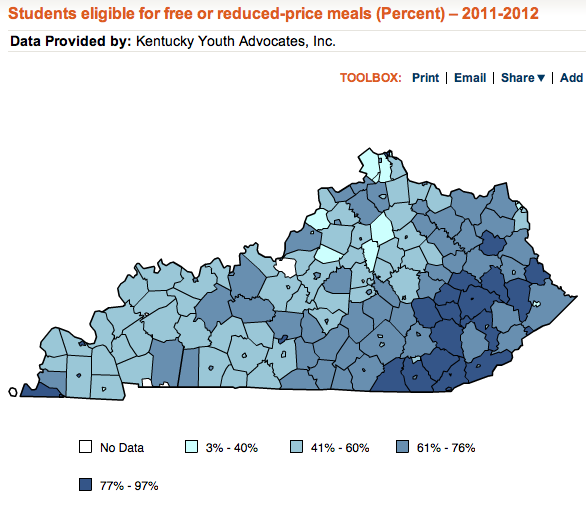
Where poverty hits hardest (KidsCount data!)


The map above comes from the newly-released 2012 KidsCount reporting on individual school districts, counties, and congressional districts.  In it, you can see a fresh illustration of how many students across the state are growing up in homes with low incomes.

You can also see an illustration of how those difficulties cluster across the state.  The eastern  counties grab the eye, and don't miss Fulton at the opposite end of the state.  Since they're harder to see, I'll also note that there are a set of independent districts also in the dark, difficult blue:

  • Covington, Dayton, Newport, and Silver Grove in the north.
  • Middlesboro and Jenkins in the east.
  • Caverna in the central west.
  • Fulton Independent, Mayfield, and Paducah in the far west.

I love the way the Kids Count maps include the range, letting you know that the state ranges from 3% to 97% participation in the free and reduced-price meal program.  To illustrate where that range occurs, I'll include tables below listing the highest 10 and lowest 10 participation rates.  I do hope you'll play with the KidsCount information for yourself, and I'm working on several more posts on what I'm seeing as I explore.

Tuesday, December 18, 2012

Wednesday, December 12, 2012

Common Core Reading: A Full Range of Texts

I've now seen multiple authors claim that the Common Core State Standards mandate that reading and English classes can only have 50% of their texts be literature, with the other 50% a variety of non-literary readings.  For example, there's this new Heritage Foundation publication, and last month there was this (now corrected) New York Times piece.

That claim is untrue, and this post offers a review just how and why it is false.

Lets start with the one place that Common Core uses the number 50%: it's in this table on page 5 of the official standards document:
The document then explains that the Standards "aim to align instruction with" the NAEP reading framework, which does mean 50% literary reading in grade 4 and then smaller shares in grade 8 and grade 12.   

The thing is, that does not mean 50% of an elementary school's reading hour or 30-45% of the one period a day the upper grades devote to language arts and English.  Common Core stakes a claim to the full instructional day and homework time beyond that.  

Here's the key Common Core statement that appears right below that table:
In K–5, the Standards follow NAEP’s lead in balancing the reading of literature with the reading of informational texts, including texts in history/ social studies, science, and technical subjects. In accord with NAEP’s growing emphasis on informational texts in the higher grades, the Standards demand that a significant amount of reading of informational texts take place in and outside the ELA classroom. Fulfilling the Standards for 6–12 ELA requires much greater attention to a specific category of informational text—literary nonfiction—than has been traditional. Because the ELA classroom must focus on literature (stories, drama, and poetry) as well as literary nonfiction, a great deal of informational reading in grades 6–12 must take place in other classes if the NAEP assessment framework is to be matched instructionally.  [emphasis added]
Why does Common Core call for literature and more, studied in English classrooms and many others?

It's because today's students will read widely as tomorrow's adults:

  • In their careers and postsecondary education, they'll need to read everything from scientific research and economic analysis to manuals for advanced machinery and guidance on implementing complex legal requirements.
  • As citizens and community participants, they'll need to read analysis of current events, speeches, editorials, historical explanations, and on and on. 
  • As members and builders of our shared culture, naturally they'll also need to engage literature and richly literary nonfiction. 

For our next generation, reading will be a mix of all those kinds of texts, so Common Core calls on our schools to equip them for that full range of expectations.

In fact, the  document's proper name is "Common Core State Standards for English Language Arts & Literacy in History/Social Studies, Science, and Technical Subjects."  The proof that  Common Core aims for high levels of fluency with literature and other reading texts, learned in English and other classrooms, is right there on the cover.

One more thing:  Kentucky science, history, and other teachers are doing fabulous work to build those reading skills.  Even if the Times has to correct its publications and even if Heritage never bothers to check its facts, our educators are engaging Common Core fully and thoughtfully, and our students are already gaining ground as a result.

School Districts of Innovation

David Cook Talks About Kentucky's implementation of Districts of Innovation

http://blogs.edweek.org/edweek/engagement_and_reform/2012/12/districts_of_innovation.html

Tuesday, December 11, 2012

Delivery targets: impact on overall scores

Meeting 2013 delivery targets will produce impressive growth in the "overall scores" that combines all of a school's data in a single accountability number on a 0-100 scale.

For example, meeting delivery targets will result in:

  • 3.3 points improvement in the statewide elementary overall score.
  • 4.0 points improvement in the statewide middle school score.
  • 3.3 points improvement in the statewide high school score.

Improvement will be quicker for schools with results below the statewide level, and slower for those above. That's because delivery targets expect more improvement from those who have more to improve.

Because delivery targets are so ambitious, they can also have a big impact on schools' AMOs (short for annual measurable objectives).  AMOs are another part of our new approach to accountability, and they work by taking schools' overall score and asking for increases of:
  • 1.0 points from schools in the bottom 70% for their level.
  •  0.5 points for schools in the top 30% for their level.
Schools that make their delivery targets will exceed their AMOs with plenty of margin to spare!

Better yet, meeting delivery targets will allow schools to move rapidly toward overall scores of 100.
That's sweet news, because 100 is the overall score that will mean all Kentucky students are on track to graduate ready for college and career after consistently making expected growth.

Note to arithmetic lovers: my basic method here is to work out how much each subject's 2012 percent proficient will improve to hit that subject's 2013 delivery target; then multiply by 20% to show how that will change the achievement part of the overall overall score; and then work out how much that will change the overall score by multiplying by 30%, 28%, or 20% for elementary, middle or high schools.  I repeated the same approach for the gap group.  For middle school, I added in a readiness target weighted at 16%, and for high school I added in readiness and graduation each weighted at 20%. E-mail me if you want to see the whole set of calculations.